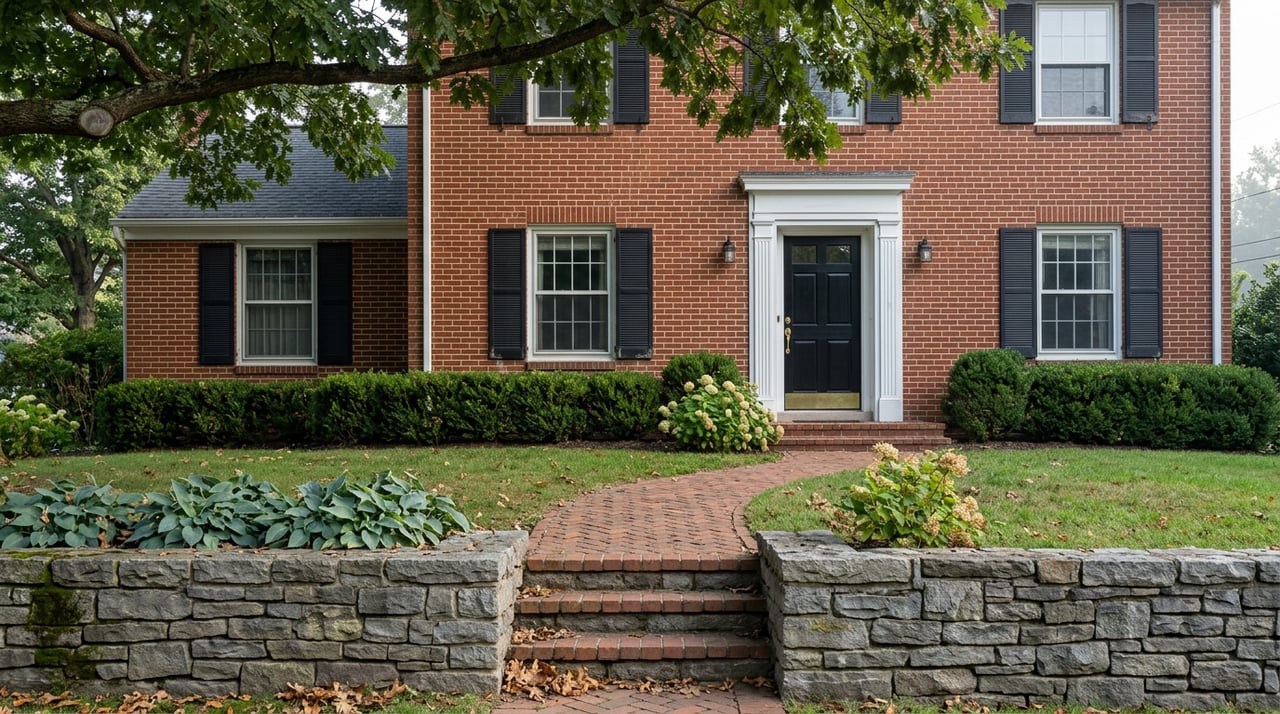
In Spring Valley, "Cleanup Complete" Meant One Address, Not the Whole Neighborhood
August 27, 2026
August 27, 2026
Ask a title officer who has closed more than a handful of deals in Spring Valley and you will hear some version of the same question land mid-contract: does this property have any documentation from the Army Corps of Engineers? The seller, who has lived in the house for fifteen years and never received a letter about anything, is often caught off guard. So is the buyer's attorney, who assumed the neighborhood's chemical weapons history was settled years ago because that is what the news coverage said.
Both are partly right. In November 2021, the Army Corps of Engineers announced that the most contaminated site in Spring Valley, a quarter-acre lot at 4825 Glenbrook Road NW, was fully cleaned and safe to build on. That is a real milestone and it closed out the most difficult chapter of a cleanup that had run for nearly three decades. But the announcement was about one property. It was never a neighborhood-wide clearance, and the paperwork question it raises for buyers has not gone away just because the headline said the work was done.
Spring Valley sits on top of what the federal government still classifies as a Formerly Used Defense Site, a designation covering roughly 660 acres and about 1,600 private properties, several embassies, and the American University campus. During World War I, the land hosted the American University Experiment Station, where the Army developed and tested chemical agents including mustard gas. When the labs were dismantled after the war, chemicals, lab glass, and munitions were buried in disposal pits across the site. A utility contractor found the first buried ordnance in 1993, and the Army Corps has been investigating and remediating the site ever since.
What most people do not realize is that this cleanup was never a single, uniform program. It was two separate efforts with two separate footprints.
| Program | Properties Involved | Result |
|---|---|---|
| Arsenic soil testing | 1,632 residential, federal, and commercial lots sampled | 177 lots required excavation and off-site removal of contaminated soil |
| Buried ordnance investigation | 92 private properties identified as possible burial sites | 85 remediated as of the most recent published count |
| Groundwater monitoring | 55 monitoring wells across the site | Ongoing, with perchlorate detected above the EPA's interim health advisory level at two locations |
The arsenic testing covered nearly every lot in the FUDS boundary. The ordnance investigation, the part of the story that produced the dramatic headlines about hazmat suits and buried munitions, only ever applied to a much smaller group of properties near known disposal pits, mostly along and around Glenbrook Road. A home two blocks away that was never in the ordnance investigation pool has a completely different documentation history than one that was.
That distinction matters at closing, because the Army Corps' Spring Valley project page still describes ongoing groundwater investigation and monitoring even after the Glenbrook Road milestone. Arsenic in groundwater had exceeded the drinking water standard in one area, though testing in 2019 showed the level had dropped back below the limit. None of the groundwater at the site is used as a drinking water source, but the monitoring wells are still there, and the file on any given property is still open in a technical sense even when the neighborhood as a whole is considered safe.
Washington's Seller's Property Disclosure Statement, governed by DC Code § 42-1309, requires sellers to describe the condition of the property to the best of their actual knowledge, and that includes environmental hazards such as contaminated soil. Sellers are not required to hire an inspector or test the property before filling out the form. If a seller genuinely does not know about a past remediation, checking "unknown" is legally acceptable. The Nolo legal guide to DC disclosure obligations is a useful plain-language reference for exactly what the form covers and how the actual-knowledge standard works.
The form has to be delivered before or at the time the buyer signs a purchase agreement. If it arrives late, the buyer can cancel the contract within five calendar days and get their deposit back. That deadline pressure is the same for every DC seller. What changes in Spring Valley is what a buyer's side does with the form once they have it.
A seller who checks "unknown" on the environmental section is being honest. But an experienced buyer's agent or real estate attorney working in Spring Valley knows the neighborhood's history well enough to ask a follow-up question the form itself never poses: has this specific address ever received documentation from the Army Corps, one way or another?
That question exists because the Corps has, at various points in the project, issued written assurance to individual property owners confirming that a lot met the cleanup standards its regulators agreed to. Those letters were meant to be shared with future buyers and their agents. A seller who has one can hand it over and settle the question in a single document. A seller who does not have one, whether because the lot was never flagged for testing or because the letter was misplaced decades ago, is often asked to help track down the property's status through the Corps' public records before the deal can move forward comfortably.
None of this is required by DC's disclosure statute. It is a practice that has grown up around the statute because Spring Valley's history makes buyers and their attorneys want more certainty than a checkbox provides. On a property with a straightforward arsenic-testing record and no ordnance history, that usually means a quick records check. On a property closer to the historically flagged blocks, it can mean a longer conversation.
The same data source, five months apart, tells you how thin this market really is. In October 2025, Redfin recorded a median sale price of $2.0 million in Spring Valley, down 20 percent year over year, with homes taking an average of 107 days to sell compared to 30 days the year before. By March 2026, the median sale price on the same portal had swung to $2.55 million, up 18.6 percent year over year. That is not a market correcting itself. That is a neighborhood where so few homes close in any given month that one or two unusually large or unusually modest sales can move the median by hundreds of thousands of dollars in either direction.
Broader regional data for April 2026 from the Greater Capital Area Association of Realtors showed 4,591 active listings across the metro area, a contract ratio of 0.44, and an average of 36 days on market for the region as a whole. That points to a buyer-favorable environment across the DMV generally, which is doing more to explain typical days-on-market swings than any single documentation request. Condition and presentation also carry real weight here, since the neighborhood's housing stock spans original 1930s and 1940s construction, partial updates, and full renovations often within the same block, and current buyer preference favors move-in-ready kitchens and baths over projects.
Where the environmental paperwork tends to show up is not in the sale price. It shows up in the calendar. A records request to the Corps, or a search through the project's public documentation, can add real days to a closing timeline on properties where the history is not already gathered and ready to hand over.
Sellers who prepare for this conversation before it comes up tend to have a smoother process than those who wait for the question:
Does every home in Spring Valley need a special environmental inspection before it can be sold? No. DC does not require environmental testing as part of the standard disclosure process. The question of documentation comes up because of buyer diligence in this specific neighborhood, not because of any additional legal requirement beyond the standard DC disclosure statute.
Is the arsenic or buried ordnance risk still active today? The Army Corps considers the highest-risk site, Glenbrook Road, fully remediated as of 2021, and arsenic soil remediation across the sampled lots was completed years earlier. Groundwater monitoring continues at the site, though the groundwater there is not used as a drinking water source.
Where can I find my property's remediation history? The Army Corps of Engineers, Baltimore District, maintains the official Spring Valley project records. A real estate attorney familiar with the neighborhood can help track down whether a specific address was ever part of the arsenic testing or ordnance investigation pools.
Spring Valley's history is part of what makes it distinctive, not a reason to hesitate. Buyers who understand the paperwork ahead of time move through it quickly, and sellers who gather their documentation early rarely find it slows anything down at all. If you are weighing a sale or purchase in Spring Valley and want a clear read on what your specific address will need, Pryor Residential & Co. is glad to walk through it with you. Let's Connect.
This article is general information, not legal, tax or financial advice. Consult a qualified professional about your situation.
Stay up to date on the latest real estate trends.
A strategy-first approach, elevated service, and attention to detail define every client experience. From luxury homes to high-value transactions across DC, Maryland, and Virginia, every step is guided by thoughtful planning, strong communication, and a commitment to achieving exceptional results.